Address by Chair at AGM 2026
Dr James Kember, Former Chair of the National Board NZIIA, 2024-2026
2026-05-13
NEW ZEALAND
GEOPOLITICS
This address was first delivered to the NZIIA National Annual General Meeting in Wellington on 13 May 2026.
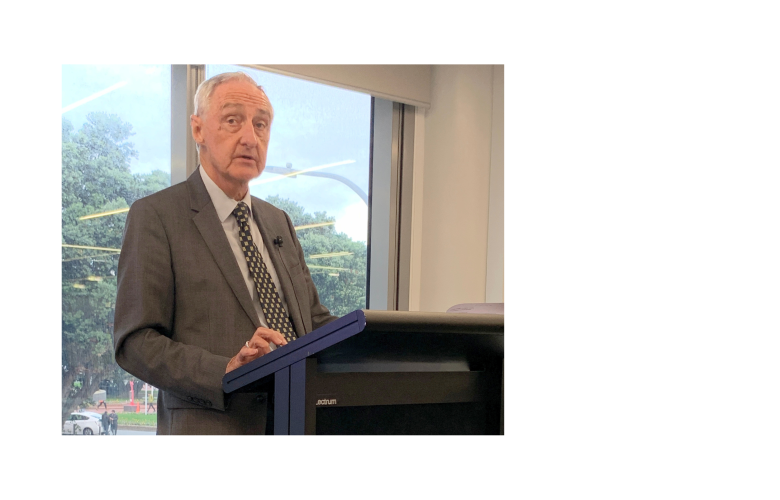
Kia ora ki te whare tawahi-a-mahi I Aotearoa.
I begin today by noting with sorrow the passing this morning of Professor Sir Kenneth Keith at the age of 88. Sir Kenneth, a graduate of the University of Auckland, Victoria University of Wellington and of Harvard, was an eminent jurist and legal scholar, and author of several important legal works. His career began in the then Department of External Affairs, and included several periods in the Law Faculty of Victoria University of Wellington, as a justice of the Court of Appeal, an inaugural judge of the Supreme Court, the presidency of the Law Commission and, from 2006-2015, as one of the judges of the International Court of Justice in The Hague - the first and, for now, only New Zealander ever to be elected as a member.
From 1972-1974, he was Director of the New Zealand Institute of International Affairs (NZIIA), and later its President, from 2000-2007. I ask you to join me in a moment of silence in his honour. Thank you all.
----------------------------------------------
Today marks a year and a week since our last Annual General Meeting, when I last stood before you to open the discussion about the work of the Institute and especially its branches over the preceding year.
I would like to begin with some comments from a previous national meeting of the Institute, that still speak to some of its fundamental objectives and to the dedication of at least one long-serving member.
First, on the matter of the role of this organisation in promoting understanding of international issues affecting New Zealand: “the aims of scholarship in foreign affairs continue to be served by the preparation of the Institute’s …Survey [New Zealand in World Affairs] volume..that will become a standard work of reference in New Zealand and abroad, and will give the Institute added stature and authority”.
Secondly, on publications: “The President noted that clearly the International Review and the Survey volume had to continue… and the Auckland representative said he would like to see all members having to subscribe.”
Then on membership: “The Institute’s links with corporate members [1975: 28, 2025: 23] have not been as strong as might have been the case in the past…is it time for the envisaged membership drive to take place…and build up a record of activities more interesting to them?”
Reference was made “to the Ministry’s willingness to help procure speakers….it [being] particularly important for the Institute as a national body to host important speakers outside Wellington” [and to]….good liaison with the Ministry of Foreign Affairs.
“In conclusion appreciation was expressed of the longstanding and inestimable services of the Treasurer, Professor Trow.”
Those are all extracts from the minutes of a six-hour Saturday meeting of the Institute National Council on 24 April 1976. The comments on publications and speakers were from then-President Professor Quentin Quentin-Baxter It is just fortuitous that this year marks 50 years since I first attended an AGM, in the capacity as Executive Secretary of the organisation; and the corporate membership reference was in a paper I had prepared for that meeting. As a matter of interest, some of these matters, like the importance of our flagship publications, were issues discussed earlier today in our meeting with Branch Chairs.
You will be relieved to know I am not about to embark on a five-decade survey, given that my mandate is to cover the events of 2025. But if I kept to that year, it would of course be to neglect mention of the Iran conflict this year which, even if a permanent ceasefire were to take effect tomorrow, is going to have consequences of very long duration – political, security and economic. It will beg for some years ahead many questions about supply chains, some of which were the focus of the Prime Minister’s meetings in Singapore earlier this month.
The attack on Iran’s nuclear facilities in the middle of last year should have been seen as a likely precursor of more intensive action. The continuing wars in Ukraine, where there have been around 2,000,000 military casualties, and in Sudan, where the death toll is now around half a million, still lack for resolution. Closer to us, the clashes between India and Pakistan, and on the Cambodia-Thai border, are concerning. In Gaza, there has been some relief, but without as yet the enduring outcomes most needed. Overshadowing much of this is the relentless march of a Trumpian foreign policy, with withdrawal from major international institutions, questions over adherence to the rule of law, not to mention the events in Venezuela. Perhaps it is little wonder that the US Council on Foreign Relations has characterised 2025 as one “offering few instances of inspiration”.
Our very successful national conference last year addressed some of the current challenges, to which we seem to have added rather than resolved. And I haven’t touched on climate concerns, or the races going on in the AI and rare-earth domains. AI is almost certainly one of the most pressing topics on the Trump-Xi agenda for the talks in Beijing later this week. What all of this means is that there are topics aplenty to be addressed, unpicked and discussed in branches and through the National Office. And in that regard, a shout-out to the Wellington Branch for its forthcoming meeting on AI and the Future of Government. In a world of upheaval and fundamental change, of challenges previously unimaginable, the need “to promote an understanding of international questions and problems as they affect New Zealand” is as great today as when those words were used in an Institute publication in 1938. Let those admonitions about the key tasks for the Institute serve as a reminder that they retain validity all these years later.
The Institute’s ability to operate is very much dependent on the support and financial assistance we receive, notably from the Ministry of Foreign Affairs and Trade for the staffing of the National Office, and other organisations which help in the funding of events like the conference. On behalf of the Institute, I express our deepest appreciation, and also warmest thanks, to Te Herenga Waka Victoria University of Wellington which, as long as I can remember, has provided not only office space but also – in return for the interaction with its students and staff – access to meeting space and facilities essential to a good operation.
In my foreword to the Annual Report before you, I commented on some of the longer-term changes that have taken place in recent years, including the new constitution, the conclusion of the term of office of our former Executive Director, Dr Hamish McDougall, the preparations for a new volume in the series New Zealand in World Affairs that will be available shortly, and the changes to our flagship publication, New Zealand International Review, including the appointment of a new editor, Dr Mathew Doidge. I take the opportunity to thank the many contributors to the magazine for their insightful observations on international affairs, and those who served as members of the editorial committee. Indeed, the on-going publications work is core business for the Institute, just as it was identified as such in the 1976 minutes from which I quoted earlier.
We lost some of our stalwarts in the course of the last year. Former Institute President and Foreign Minister Russell Marshall and former Secretary of Foreign Affairs and Trade, Richard Nottage passed away in 2025. More recently, it was former diplomat and Executive Director, Gerald McGhie, whose work with the magazine continued until shortly before his passing. There is a fine tribute to him from Dr Ian McGibbon in the latest issue of the Review.
Ian’s willingness to continue contributing from time to time to a publication which he edited for 40 years, is very much appreciated. We had the opportunity to thank Ian at a function at the end of 2025, but I would like to put on the AGM record our warmest thanks to him for having managed the Review for so many years.
I should also note, though again a 2026 event, the passing of Dr Barry Macdonald, who was a key supporter of the Institute in Palmerston North and served on the Research Committee. He appears in the record of that 1976 meeting I quoted earlier.
Straying a little further into the events of 2026, I want to acknowledge the appointment of our new Director, Catherine Grant Makokera, and to wish her, and our Administrator, Yvonne Palmer, well for the coming years. Thanks too to Dr McDougall for his excellent work as our Executive Director over the past four years, and to Yvonne Palmer whose continued great service as the Institute Administrator is so important to the good running of this organisation. I must also offer my warmest thanks to our Patron, Sir Anand Satyanand, who has been a constant support and adviser to me and the Institute as it has set out in new directions. Thanks too to our indefatigable Independent Chartered Accountant, Professor Don Trow, whose involvement with the Institute is, as I said earlier, even longer than mine. It is in many ways thanks to some key people here and in the branches that the Institute is in such good heart. The work of branch chairs, committees and volunteers are critical to the success of the programme of events run in each centre.
Finally, and not least, I pay tribute to those with whom I have had the privilege of serving on the national body, including Dr Serena Kelly who has been our Vice Chair during my term as Chair. And also special thanks to Suzannah Jessep, with whom I have very much enjoyed working over two terms on the board, and who, like me, stands down today in favour of newly-elected board members Rosemary Banks and Julia Macdonald. They join a group of existing and re-elected members who are dedicated to furthering the objectives of an organisation whose centenary now approaches.
Dr James Kember recently completed his second and final term on the Board of the Institute, the last two years as its Chair. Previously he was the Chair of the Institute’s Research and Publications Committee.

Membership
NZIIA membership is open to anyone interested in understanding the importance of global affairs to the political and economic well-being of New Zealand.