Astropolitics of Fiji: An Introduction
Marçal Sanmartí
2025-12-04
PACIFIC
GEOPOLITICS
This article first appeared on the Australian Institute of International Affairs "Australian Outlook'
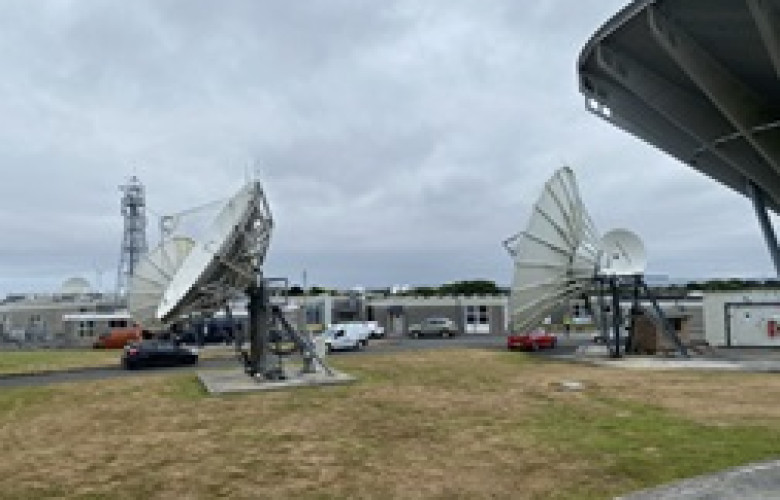
South Pacific Island nations are increasingly engaging with satellite technologies
For Small Islands Developing States (SIDS), space technologies are more related to pure survival than the pursue of international glory. Many of these countries are literally sinking due to climate change. Satellite technologies imaging climate events can help the planning against cyclones flooding and erosion but also help these countries access funds to fight climate change.
These technologies provide SIDS with surveillance capabilities to control boats fishing illegally and trafficking drugs as well. Drug trafficking, and the organised crime related to it, is a problem that bigger nations also struggle with but for SIDS has devastating consequences. That is why some time ago, Fiji announced the creation of a new narcotics and drugs bureau to deal with a surge in drug trafficking cases and crimes in the island nation, after police seized millions of dollars in raids.
Providing internet connection is another opportunity that satellite technologies can bring to SIDS. Specially in the South Pacific, weather events such as volcanoes and earthquakes can cut submarine cables connecting these islands among themselves and the rest of the world. We saw that back in 2022, during the volcano eruption in Tonga: the United Nations (UN) and Starlink collaborated to reconnect Tonga to the Internet through satellite technology.
Satellites can also support the transition from fossil fuels to renewable energy in SIDS by helping them situate renewable energy infrastructure where they can get the most of it. This is critical infrastructure for South Pacific nations, not just to fight climate change but to secure energy supplies.
Fiji is “friends to everyone, enemies to none” but on a different scale
South Pacific Island Nations have historically navigated geopolitics in the region by balancing their relationships with regional and world powers. The scope of the geographical size, population and location of these island nations makes collaboration, rather than confrontation, a must. Still, Fiji´s geography and population put this island nation in a slightly different group.
Fiji is an archipelago with a surface area of 18,274 square km and a population of around 932,000 people. It is bigger and considerably more populated than other SIDS in the South Pacific region. That provides Fiji with a series of capabilities that have a direct influence on the quantity and intensity of its international engagements, including defence, and the satellite technologies related to them.
Engaging in satellite technologies and other space matters with South Pacific nations, India, the West but also China
Fiji is an active member of the Pacific Community and its Geoscience, Energy and Maritime division supporting Pacific nations overcome diverse challenges. The Division´s Earth and Ocean Observation team uses satellite data to track coastlines and the impact caused by disasters or climate change and determine affected areas quickly. Fiji is also base to the Pacific GIS & Remote Sensing Council (PGRSC), a regional body that develops and promotes expertise in Geographical Information System (GIS) and Remote Sensing across the Pacific Islands. It serves as a hub for collaboration, training, and knowledge-sharing among governments, researchers, NGOs, and private sector partners.
For some time, Fiji and India have also built a special relationship. That is also the case in space related matters. Indian Prime Minister Narendra Modi acknowledged in 2014 the role played by Fiji in the success of India’s first Mars mission and offered to make Fiji a hub for regional collaboration in space. The Indian Space -Agency, ISRO, is currently exploring the possibility to receive satellite tracking support from Fiji in future research missions to the Moon and the Sun.
As we mentioned before, Elon Musk offered his Starlink satellite constellation to help re-establish communications in Tonga after a volcanic eruption. A SpaceX team went to Fiji to establish a station to help reconnect Tonga. Separately, a UN team also provided small satellites and other telecommunications support to re-establish communications from Fiji as well.
Regarding defence partnerships, Fiji hosts the US-led multinational Cartwheel exercises on Pacific threats. The 2022 exercise involved defence personnel from the Republic of Fiji Military Forces, the United States Army Pacific, the New Zealand Defence Force, the British Army and the Australian Defence Force. In there, Major Atonia Nagauna of the Fiji Infantry Regiment, stated that Pacific nations faced challenges that require collective action, including natural disasters and illegal fishing. Issues that can be addressed with the assistance of satellite technologies as we mentioned before. That points that Fiji might start engaging on satellite positioning technologies for defence purposes within the Cartwheel exercise countries in a not far away future. Interestingly, in 2024, Fiji signed a Memorandum of Cooperation with Japan for an Early Warning Satellite System (EWSS), leveraging Japan’s Quasi-Zenith Satellite System. The intention is to enhance Fiji’s disaster preparedness and strengthen regional cooperation on emergency warning systems, but the system could be adapted for surveillance purposes as well. Even more interestingly, the 2025 edition of the Cartwheel exercise featured troops from Fiji, the United States, Australia, New Zealand, the United Kingdom, Germany and Tonga but also Japan.
At the same time, Fiji can engage with China. People´s Liberation Army Navy ships have visited Fiji several times, including tracking ships, that made at least four stops in Fiji in 2022 alone. Nominally, these vessels deploy globally as part of the China Satellite Maritime Tracking and Control Department’s space flight tracking and data network, as well as occasionally conducting community relations events during their port visits. However, some Australian media have reported that these ships in Fijian waters might be performing spying activities on Australian naval assets.
Towards a Fijian space agency?
Fiji is signatory of key UN space treaties: the Outer Space Treaty governing peaceful use of outer space, the Rescue Agreement addressing astronaut rescue and the Liability Convention governing the liability for damage caused by space objects. Fiji is also a member of the International Telecommunication Union and a subscribing state to the Hague Code of Conduct on ballistic missile proliferation.
Furthermore, Fiji has three universities offering science studies in maths, physics and communications, and a satellite tracking station. The country also enjoys a geographical position that is not far away from the equator, is surrounded by water, and does not have much radio or light pollution. That gives the country potential for various space-related activities like observation of objects, satellite signal tracking or even rocket launching in the future.
We can argue that opportunities to address various issues through satellite technologies, the international engagements and the internal assets provide Fiji with the opportunity to create its own space agency. Space agencies can come in a variety of shapes and sizes, and it would not be the first case among SIDS. In fact, the Maldives created in 2022 its own space agency to address issues shared with other SIDS: climate change, protection of the maritime domain and diversification of a national economy heavily dependent on tourism.
The potential creation of a Fijian Space Agency would not just create a new tool to achieve solutions for existing issues but also the will to coordinate some of the already existing international engagements related to accessing space. The plurality of these engagements are not just an expression of Fiji´s navigating a multipolar world, but also the increasing use of satellite technologies for multiple purposes, including defence.
Sovereign access to space and the national assets established there (mostly satellites and the information they provide) is becoming a priority worldwide. However, a question remains: Would that access be available for countries which need it the most?
Marçal Sanmartí is a researcher at the New Zealand Institute of International Affairs where he does analysis about the politics of outer space or Astropolitics. He also has collaborated with the Catalonian Global Institute, Access Hub Space, Espai.media, and the Space Review among others.
Photo: Matthew Prior, CC BY-SA 4.0 <https://creativecommons.org/licenses/by-sa/4.0>, via Wikimedia Commons

Membership
NZIIA membership is open to anyone interested in understanding the importance of global affairs to the political and economic well-being of New Zealand.