Beyond Friendship: Strategic Alignment between New Zealand and Japan
Tadashi Iwami, Lecturer, Hokkaido University, Japan
2026-03-03
ASIA
GEOPOLITICS
From New Zealand International Review Mar/Apr 2026

Common geopolitical concerns, commitment to multilateralism, and mutual public trust underpin this development. Wellington and Tokyo now prioritise security cooperation, developing aligned security frameworks while increasing operational interoperability. Under the current leadership of both countries, their partnership has gained clearer strategic purpose. As maritime competition intensifies, New Zealand and Japan must prepare for more frequent regional challenges and deepen practical defence cooperation in the Pacific, including future maritime capability and reciprocal access to their defence resources.
On 21 October 2025, Liberal Democratic Party (LDP) Pres ident Sanae Takaichi became Japan’s 104th – and first female – Prime Minister, more than a quarter of a century after New Zealand reached the same milestone. Her appointment is significant not only for its symbolism. Her leadership is a continuation of Shinzō Abe’s policy direction of increased defence spending, the easing of arms export restrictions, and greater foreign policy engagement, given her longstanding as sociation with him.
As of 9 February 2026, Japan under Takaichi has entered a significant new political phase. Following a historic landslide victory, Takaichi’s LDP has secured an unprecedented standalone supermajority in the lower house, effectively consolidating her political power. In light of this historic shift in Japanese politics, what should New Zealand understand about its partner? And how will the two countries – friends and strategic partners in the Pacific – navigate increasingly contested Indo-Pacific waters?
This article offers a multilayered overview of the New Zealand–Japan relationship. It:
- Outlines the strong foundations built on economic ties, people-to-people connections, and genuine mutual trust and confidence;
- Considers how the two countries’ leaders talk about each other;
- Identifies the key features of an increasingly institutionalised strategic partnership;
- Assesses Prime Minister Takaichi’s strategic policy direction and its implications for New Zealand; and
- Highlights the undeniable realities both countries must con front as maritime competition intensifies across the Indo Pacific.
Taken together, these developments reveal a relationship characterised by an unmistakable deepening of strategic purpose. Linking two liberal democracies whose values, interests and policy directions are increasingly aligned in navigating a more contested Indo-Pacific space.
Foundations: Economic Ties, People-to-People Connections, and Positive Perceptions
Broadly speaking, the relationship between New Zealand and Japan has been well-established, deeply intertwined, and steadily nurtured over the past 70 years. The modern bilateral relationship began in 1952, when Japan signed the San Fran cisco Peace Treaty, formally ending the war in the Pacific. Following the first substantive bilateral trade agreement in 1958, both countries focused primarily on economic partnership, while deliberately downplaying politically sensitive issues such as regional security.
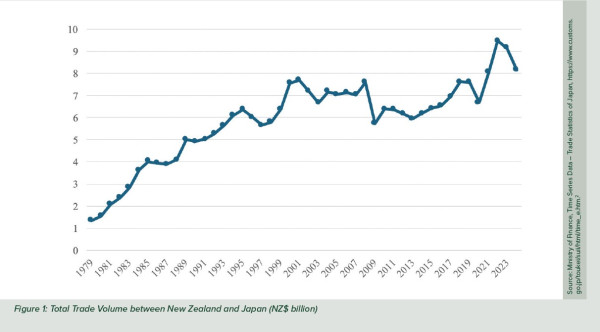
As the data in Figure 1 below indicates, total nominal trade (exports plus imports) between New Zealand and Japan has grown consistently over time. Japan remains one of New Zealand’s major trading partners, following China, Australia, the United States (US), the European Union and Singapore. In the dairy sector, Japan is New Zealand’s major export market, accounting for NZ$886.9 million (16.7% of total exports to the country) of exports in the latest figures.2
More recently, economic ties have been further institutionalised through regional trade frameworks, including the Comprehensive and Progressive Agreement for Trans-Pacific Partnership (CPTPP) since 2018, and the Regional Comprehensive Economic Partnership (RCEP) since 2022. As founding signatories, both New Zealand and Japan have practically replaced the United States as a central power, taking a central role in advancing a freer and more open economic architecture across the Indo-Pacific and beyond. This multilateral architecture has become increasingly important as both countries confront shared challenges, ranging from the uncertainty created by US tariffs to China’s growing use of eco nomic coercion and export restrictions as strategic instruments used for political gain.
People-to-people links have traditionally also been strong. For decades, Japanese tourists have regarded New Zealand as one of the most attractive tourist and educational destinations (as did I). At their peak in 2002, more than 173,500 Japanese visited New Zealand annually. The prolonged economic stag nation Japan experienced from the 1990s to the 2010s, how ever, saw this number fall below 70,000. In the post-COVID period, the recovery has been steady: Japanese visitor numbers reached around 67,000 in 2024. This is still less than half the 2002 peak, but rising.3
For New Zealanders, Japan has become increasingly popular as a travel destination too. The number of New Zealand visitors to Japan has already surpassed pre-COVID levels, rising from a little over 61,000 in 2019 to more than 76,000 in 2024. In fact, more New Zealanders visited Japan than Japanese visited New Zealand in 2024.4
People-to-people connections are reinforced institutionally through sister-city relationships. According to the Embassy of Japan,⁵ New Zealand has 44 sister-city relationships with Japan. This is the highest number it holds with any country. While quantity is not everything, this demonstrates the depth of engagement at both the individual and regional levels, and the extent to which the relationship is embedded across society.
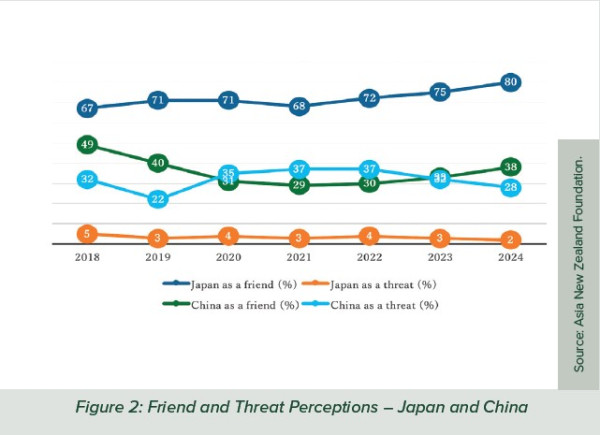
Public perceptions in New Zealand toward Japan are also overwhelmingly positive. The latest Asia New Zealand Foundation survey6 shows that Japan is regarded as one of the two most important countries in Asia (alongside China), with 73% of respondents rating it as important or very important. An impressive 80% consider Japan a ‘friend’ to New Zealand, a steady rise over the past seven years. This contrasts sharply with China, which only 38% view in a similar light.
When asked about trust, 62% of respondents expressed a high level of trust in Japan, compared with only 4% expressing low trust. For China, the pattern is reversed: 14% expressed high trust, while 48% expressed low trust (with 34% neutral). Figure 2 below illustrates these trends in New Zealanders’ friend/threat perceptions of Japan and China over the last seven years.
Japan is, therefore, seen as probably the most reliable partner New Zealand has in Asia, a judgement that says much about whom New Zealanders believe they can trust in an increasingly complex region.7 Public sentiment at the societal level is especially significant in liberal democracies like New Zealand and Japan, where strategic policy settings are shaped and refined not only by governments, but also by the wider public’s confidence in key partners.
What Leaders Say: From Shared Values to Strategic Alignment
How have sustained free and open economic ties, strong people-to-people connections, and positive public perceptions of Japan influenced New Zealand’s political narratives? A clear development can be seen in both the quality and density of political narratives over the last two decades – from shared values to strategic alignment.
In the late 1990s and early 2000s, leaders in Wellington and Tokyo consistently highlighted the values they held in common: freedom, democracy, human rights, a market-oriented economy and the rule of law. Descriptions such as ‘natural partners in the Asia-Pacific’ centring on these shared values captured the tone of the era. In 2008, Prime Minister Helen Clark and Prime Minister Yasuo Fukuda agreed, for the first time, to begin strengthening security and defence dialogue, an important symbolic step, although concrete progress initially remained limited.
That progress came in 2013, which proved to be a decisive turning point. Foreign Ministers Murray McCully and Fumio Kishida elevated the relationship to a Strategic Cooperative Partnership, signalling a growing recognition that converging shared liberal values alone were no longer sufficient; the regional environment now required them to seek possible strategic coordination. This elevation reflected a shared understanding that economic interdependence, regional uncertainty, and shifting power dynamics in the Pacific demanded deeper and more structured alignment.
Prime Minister John Key acknowledged New Zealand’s need to engage more actively as the strategic environment changed, while Prime Minister Shinzō Abe sought for Japan to contribute proactively to regional stability through the Free and Open Indo-Pacific (FOIP) vision. Their successors, Jacinda Ardern and Fumio Kishida (the same Kishida who promoted the 2013 Strategic Cooperative Partnership as foreign minister), made this shift more explicit when they met in Tokyo in 2022. They affirmed that New Zealand and Japan were now ‘key partners in advancing and protecting peace and security in the IndoPacific’.8 The narrative had clearly moved beyond shared values to gradual strategic alignment.
Prime Minister Christopher Luxon’s visit to Tokyo in June 2024 further reinforced this evolution. While celebrating the long-term benefits of open trade, Luxon stressed that economic prosperity cannot be separated from security, an acknowledgment of New Zealand’s growing reliance on likeminded partners (including particularly Japan) in an increasingly contested region. He remarked:
Despite the distance between us – joined together, but also separated by the vast blue continent that is the world’s largest ocean – New Zealand and Japan are united in our ambition for advancing and protecting our essential economic and security interests.9
Luxon’s message aligned with the maturing strategic narrative: economic security is inseparable from national security, and New Zealand’s partnership with Japan is central to both. In the New Zealand International Review, he described Japan as an ‘important longstanding partner’, underscoring Wellington’s intention to further deepen cooperation in defence, maritime security and regional resilience.10
Although a formal summit between Luxon and Japan’s new Prime Minister Sanae Takaichi has yet to occur (as of January 2026), Takaichi has already indicated her willingness to sustain and broaden this strategic trajectory. At the ASEAN-related Summit Meeting in Malaysia shortly after her appointment in October 2025, she met briefly with Luxon, noting publicly on X that New Zealand and Japan are ‘crucial partners in promoting a Free and Open Indo-Pacific [FOIP]’. She also affirmed her intention to strengthen the 2013 Strategic Cooperative Partnership. The following day, in talks with Australian Prime Minister Anthony Albanese, Takaichi emphasised multilayered cooperation with likeminded states, including New Zealand, through the Australia–Japan security framework. From Takaichi’s perspective, New Zealand remains a trusted and strategically aligned partner in navigating the region’s intensifying challenges as well.
Strategic Cooperative Partnership
What does a Strategic Cooperative Partnership actually mean, and how does it apply to New Zealand and Japan? Broadly, a strategic partnership is a structured and goal-driven form of cooperation that enables two states to work together in addressing shared challenges – often in defence, security, and regional stability – without entering into a formal alliance. It goes beyond a transactionally calculated partnership based solely on eco nomic interests, yet remains short of a legally binding security treaty that comes with alliance-level obligations and costs.11
Such partnerships are particularly useful in today’s complex strategic environment. They provide states with a flexible institutional framework to deepen coordination, align policy directions and interests, and reinforce interoperability across areas such as security, maritime awareness and contingency planning. Crucially, they typically build on existing layers of trust accumulated through economic ties, political dialogue, and people-to-people connections. This gives the partnership a high degree of approachability, manoeuvrability, and customisability.
In the case of New Zealand and Japan, their Strategic Cooperative Partnership rests on three mutually reinforcing building blocks:
- Multilayered diplomatic consultation and interaction;
- Enhanced military cooperation and interoperability; and
- An institutional legal framework for security alignment.
Multilayered Diplomatic Consultation and Interaction
Multilayered diplomatic consultation and interaction form the backbone of the Japan–New Zealand strategic partnership, and both countries have expanded these channels significantly. Senior leaders and ministers now meet frequently in bilateral and multilateral settings. The informal Luxon–Takaichi exchange at the ASEAN-related meetings on 25 October 2025 is the most recent example.
Ministerial-level engagement has also deepened. During the intense coalition negotiations between Takaichi’s LDP and the Japan Innovation Party (Ishin no Kai), New Zealand’s Minister of Finance and for Economic Growth, Nicola Willis, was already in Tokyo (20 October 2025) meeting her counterpart Minoru Kiuchi (then Minister in charge of Economic Security in the pre-Takaichi administration, now Minister for Japan’s Growth Strategy under Takaichi).
On 2 November 2025, Defence Minister Judith Collins met the new Japanese Defence Minister Shinjirō Koizumi at the ASEAN Defence Ministers’ Meeting-Plus (ADMMPlus), reaffirming their intention to deepen defence cooperation in support of the FOIP vision. The next major step will be the first Foreign and Defence Ministers’ Meeting (the ‘2+2’), which would institution ally strengthen the diplomatic and security dialogue architecture.
These channels also extend to senior military leadership. On 20 October 2025, the Chiefs of Navy from both countries met in Japan and reaffirmed their shared roles in the FOIP framework. On the same day, the New Zealand Chief of Navy met with Japan’s former Defence Minister, where discussions included New Zealand’s early interest in procuring a Japanese made upgraded Mogami-class frigate to replace New Zealand’s Anzac-class frigates (discussed further below). At a day-to-day level, defence diplomacy is maintained through reciprocal military attachés: Japan has stationed a permanent defence attaché in Wellington since April 2022, mirrored by New Zealand’s attaché in Tokyo.
Enhanced Practical Defence Cooperation
Enhanced defence cooperation and interoperability are the second pillar of the partnership. New Zealand’s continued contribution to aerial surveillance of North Korea’s illegal ship-to-ship transfers is a prime example. Since 2018, the Royal New Zealand Air Force’s P3 Orion, and now the P8A Poseidon, have routinely operated out of Kadena US Air Base in Okinawa. The most recent deployment occurred in November 2025.
Both countries also participate in major multilateral exercises, including the US-led RIMPAC, a four-decade long tradition. A recent milestone came in September 2024 with the Multilateral Maritime Cooperation Activity in the South China Sea, where New Zealand joined the US, Australia, Japan and the Philip pines in a coordinated maritime security gesture aimed at upholding international law and interoperability in the Indo-Pacific.
Beyond multilateral engagements, bilateral defence cooperation has begun. In September 2024, the Japan Maritime Self-Defence Force ship JS Sendai and the Royal New Zealand Navy’s HMNZS Aotearoa conducted the first bilateral maritime exercise in the East China Sea, enhancing tactical coordination at sea.12
Finally, in October 2025, RNZAF’s P8A Poseidon participated for the first time in ANNUALEX 2025, Japan’s major annual maritime tactical defence exercise, alongside the US, Australia, Canada and France. Covering antisubmarine warfare, air operations, logistics, communications, and integrated aviation drills, the exercise strengthened participating countries’ interoperability and readiness in a range of contingency scenarios near Japan’s coastlines.13
Together, these activities demonstrate how ‘talking’ through multilayered diplomatic interactions and ‘walking’ through enhanced defence cooperation build practical trust and confidence, making the partnership substantive and realistic rather than symbolic.
Strengthened Legal and Institutional Basis of Security Alignment
The third building block is the strengthened legal and institutional legal basis that enables long-term security alignment. This consists of three key agreements. The first is the Information Security Agreement (ISA). While details of information sharing are classified, the agreement provides the legal basis for exchanging sensitive security-related intelligence, particularly relevant to maritime domain awareness and regional contingency assessments. Although the ISA does not automatically make Japan a member of the Five Eyes, it can effectively function as one of the ‘compound eyes’, complementing Japan’s existing information-sharing agreements with the US, United Kingdom (UK), Australia and Canada.
Second, the Acquisition and Cross-Servicing Agreement (ACSA) provides a practical legal basis for defence forces to exchange logistics, supplies, services, maintenance, and personnel support. It is central for interoperability during exercises and operations.
Japan already holds ACSAs with all Five Eyes members, as well as India, France, Germany, Italy, and soon the Philippines.
New Zealand and Japan officially signed both the Information Security Agreement (following more than a decade of negotiations) and the Acquisition and Cross-Servicing Agreement on 19 December 2025. This milestone stands as a clear sign of the substantive strength of the legal and institutional basis of security alignment.14
Third, the Reciprocal Access Agreement (RAA), which standardises legal, administrative, and procedural processes for reciprocal troop deployments, removing the need for ad-hoc arrangements. As of January 2026, New Zealand and Japan have not begun RAA negotiations.
So what is the strategic significance of such agreements? Even without an RAA, the combined effect of the ISA and ACSA will significantly deepen interoperability and logistical accessibility between the two defence forces at the practical level. To be sure, the signing of these agreements does not imply a simple shift of their strategic partnership into a full-fledged military alliance such as the US–Japan security treaty. However, they do provide an increasingly stable legal and institutional platform for structured strategic alignment. Together, they enable New Zea land and Japan to plug more effectively into a network of like-minded security partners (see Table 1), forming, in effect, a more structured multi-node security architecture among likeminded countries such as the US, UK, Australia, Canada and Japan. As defence cooperation expands with other partners including India and the Philippines, this could evolve into a more complex mini-lateral framework across the Indo-Pacific, though that path way remains challenging, particularly with India.
Strategic Partnership with Japan under Prime Minister Takaichi
With this institutional and strategic architecture in place, the question is how Japan’s new leadership under Prime Minister Sanae Takaichi might shape the next phase of defence cooperation, and what this means for New Zealand. New Zealand media largely echoed international reporting on the appointment of Sanae Takaichi as Japan’s first female prime minister, with outlets such as Reuters, Radio New Zealand, and Australia’s ABC describing her as a ‘hardline’ or ‘hawkish’ conservative.15 While such labels attract attention, Takaichi’s early policy signals emphasise a strategic outlook that is far from radical: she stresses that national security and economic prosperity are inseparable, forming the core of Japan’s long-term security strategy across the military, economic, energy, food and cyber domains in an increasingly contested Indo-Pacific.
As touched on, this logic is not unfamiliar to New Zealand. During his visit to Tokyo in June 2024, Luxon underscored exactly the same point: economic security depends on national security and vice versa. Collins also expressed a similar view when she characterised the unannounced passage and live-fire exercises conducted by three Chinese warships in the Tasman Sea in February 2025 as a ‘wakeup call’ for New Zealand. This served as a stark reminder for New Zealand that China’s expanding maritime capabilities can challenge the rules-based or der upon which the country relies, and undermine the security of New Zealand’s export-oriented economy. As Collins stated, ‘there is no economic security without national security’. In this sense, Takaichi’s strategic thinking still aligns closely with that of Luxon and Collins, and is neither more ‘hawkish’ nor more ‘hard line’ than the evolving policy approaches of many likeminded Indo-Pacific partners.
One area where we may see substantial development in the bilateral strategic partnership concerns New Zealand’s interest in Japan’s state-of-the-art upgraded Mogami-class (new FFM) frigates. They could replace the Royal New Zealand Navy’s ageing Anzac-class ships, HMNZS Te Kaha and HMNZS Te Mana, both expected to be decommissioned in the mid2030s. In August 2025, Australia announced it would purchase 11 Mogami class general-purpose frigates by 2036. Three of which will be built in Japan, and the remainder in Western Australia. The Mogami-class design suits Australia’s strategic needs: it boasts strong stealth features, requires a relatively small crew (around 90 personnel), offers flexible defence configurations, high speed and cruising range (10,000 nautical miles), and is capable of supporting a 32-cell vertical launching system.
These features also align well with New Zealand’s requirements. Frigates like the Mogami-class vessels could help ad dress the Royal New Zealand Navy’s longstanding personnel shortages: the current Anzac-class vessels require more than 170 crew each. A coordinated procurement approach, mirroring Australia’s timeline, could significantly reduce long-term operating and maintenance costs across the Tasman.
In addition, the Mogami-class frigate is natively designed to operate the US-made MH60R Seahawk helicopter, with the New Zealand government having announced in 2024 that it is negotiating the purchase of five MH60R Seahawks as potential replacements for the ageing SH2G Seasprites by 2028. While Seahawk on a Mogami-class frigate requires approximately 25 additional personnel, this creates a natural strategic synergy: selecting the Mogami-class frigate would, therefore, ensure seamless integration between ship and air capabilities, improving maritime surveillance and response capability of the New Zealand Defence Force overall.16
Together, these factors make the Mogami-class frigate an at tractive option because it offers operational efficiency, personnel sustainability, and compatibility with New Zealand’s future maritime capability. While cost remains the key factor, such a synchronised acquisition would create a ‘triple win’ for Australia, Japan and New Zealand, while further strengthening their emerging security alignment and multi-node security architecture in the Pacific.
Beyond defence cooperation and interoperability, Takai chi has identified food technology, biotechnology, and energy security, including expanded geothermal energy, as strategic priorities for Japan’s long-term economic growth. These areas provide natural opportunities for deeper cooperation with New Zealand, whose industries, research capabilities, and skilled workforce are well placed to contribute to and benefit from Ja pan’s strategic focus.
Challenges and Opportunities
Although the intensity and frequency of military threats faced by New Zealand and Japan differ considerably, New Zealand is no longer able to selectively enjoy the economic benefits of regional stability. Its obligations now extend beyond the South Pacific to the wider Indo-Pacific. Likeminded partners, including Japan, recognise and appreciate the contributions Wellington is already making as part of this shared responsibility, both eco nomically and strategically.
The ‘wakeup call’ in the Tasman Sea was ‘rare’ in 2025, but sooner rather than later it is likely to become more than a one-off event. At the current pace of strategic uncertainty, New Zealand should expect similar episodes to occur with greater regularity in the near future. Beyond more visible forms of assertive power projection in the maritime domain, New Zealand should also anticipate economic coercion targeting its primary product exports, as well as potential disruption or damage to the undersea cable infrastructure that connects it to the rest of the world, when maritime security deteriorates. Wellington will, therefore, need to confront the reality of growing maritime competition in its immediate neighbourhood, a reality that, while less frequent, bears resemblance to what Japan has faced for years in and around its own territorial waters
Looking ahead, now that the ISA and ACSA have been concluded, serving to deepen their bilateral defence cooperation in the increasingly challenging Indo-Pacific environment, a medium to long-term objective for both countries will be to further strengthen their partnership by negotiating and signing a Reciprocal Access Agreement (RAA). Together with the ISA and the ACSA, an RAA would enhance mobility, interoperability, and operational access, and would meaningfully reinforce the emerging mini-lateral security architecture in the Indo-Pacific. In this regard, the Mogami-class frigates could become the new waka for New Zealand and Japan as they navigate rougher seas ahead. In this environment, neither country can afford complacency. The message is clear: we must anticipate the unexpected, and not be caught out twice.
NOTES
1. New Zealand Trade and Enterprise, “Is Japan the Right Market?”, myN ZTE, https://my.nzte.govt.nz/article/isjapantherightmarket. Reports indicate that milk powder exports to China alone were approximately NZ$9.7 billion, accounting for around 30% of New Zealand’s total milk powder exports. See, for example, “China Remains New Zealand’s Top Milk Powder Destination,” Xinhua, https://www.chinadailyhk.com/hk/ article/583976.
2. Data converted to NZ$ using the Reserve Bank of New Zealand Exchange Rates for 22 November 2025: https://www.rbnz.govt.nz/statistics/series/exchange-and-interest-rates/exchange-rates-and-the-trade-weighted-index.
3. “Visitor Arrivals from Japan to New Zealand by Sex, 1979–2024,” Fig ure.NZ, https://figure.nz/chart/9qMIRcv0PHRLyHUstfxYkRwsiLV9aNAu.
4. “Trips to Japan Taken by People Living in New Zealand,” Figure.NZ, https://figure.nz/chart/XzWHCYPV1kErpv1oQKoxTw8Dqvp60cHs.
5. Embassy of Japan in New Zealand, “Sister Cities,” April 27, 2023, https://www.nz.embjapan.go.jp/itpr_en/sistercities.html.
6. Asia New Zealand Foundation. Perceptions of Asia: New Zea landers’ Perceptions of Asia and Asian Peoples, Wellington: Asia New Zealand Foundation, 2025. https://www.datocmsassets. com/125706/1749613534perceptionsofasia2025pdf.pdf
7. This is not to suggest that New Zealand’s other key partners in Asia are viewed unfavourably. Singapore, for example, is regarded as an equally reliable partner according to the Perceptions of Asia survey results.
8. Ministry of Foreign Affairs of Japan, “Joint Statement: Japan and Aotearoa New Zealand: Strategic Cooperative Partnership for Com mon Peace, Security and Prosperity,” 2022. https://www.mofa.go.jp/ files/100334912.pdf.
9. Christopher Luxon, “Strategic Security Speech, Tokyo,” 2024. https:// www.beehive.govt.nz/speech/strategicsecurityspeechtokyo.
10. Christopher Luxon, “Pacific Challenges,” New Zealand International Review 50, no.1 (2025): 21.
11. As for discussions on a strategic partnership, see, for example: Thomas
S. Wilkins, “‘Alignment’, Not ‘Alliance’ – The Shifting Paradigm of International Security Cooperation: Toward a Conceptual Taxonomy of Alignment,” Review of International Studies 38, no.1 (2012): 53–76. doi:10.1017/S0260210511000209
12. Japan Maritime Self-Defense Force, “JMSDF News Release, 17 September 2024,” https://www.mod.go.jp/msdf/sf/english/ news/2024/09/09171.html.
13. “Japan, U.S. Forces Begin Multilateral Exercise ANNUALEX 2025,”
U.S. Pacific Fleet, https://www.cpf.navy.mil/Newsroom/News/ Article/4325194/japan-us-forces-begin-multilateral-exercise-annualex2025.
14. Ministry of Foreign Affairs of Japan, “Signing of the Japan–New Zealand Acquisition and Cross-Servicing Agreement and the Japan-New Zealand Information Security Agreement,” 19 December 2025. https:// www.mofa.go.jp/press/release/pressite_000001_01940.html
15. Mariko Katsumura and Tim Kelly, “Hardliner Takaichi Elected as Japanese Premier, Shattering Glass Ceiling,” Radio New Zealand, 21 October 2025. https://www.rnz.co.nz/news/world/576573/hardlinertakaichi elected-as-japanese-premier-shattering-glass-ceiling; “Sanae Takaichi Wins LDP Leadership, Becomes Japan’s First Female Prime Minister,” ABC News, 5 October 2025. https://www.abc.net.au/news/20251005/ sanae-takaichi-japan-ldp-leadership-prime-minister/105853536.
16. Tadashi Iwami, “Japanese frigate may be a lifeline for New Zealand’s maritime security,” East Asia Forum, 9 January 2026. https://eastasiaforum.org/2026/01/09/japanese-frigate-may-be-a-lifeline-for-new-zealands-maritime-security/
Photo: Basile Morin, CC BY-SA 4.0 <https://creativecommons.org/licenses/by-sa/4.0>, via Wikimedia Commons
Individual copies of the New Zealand International Review may be purchased here.

Membership
NZIIA membership is open to anyone interested in understanding the importance of global affairs to the political and economic well-being of New Zealand.