India and New Zealand Turn a Trade Deal into a Strategic Partnership
Anna Mahjar-Barducci is an author, and researcher whose work focuses on the South Asia, Middle East, migration, identity, and international affairs.
2026-07-29
ASIA
TRADE AND ECONOMICS
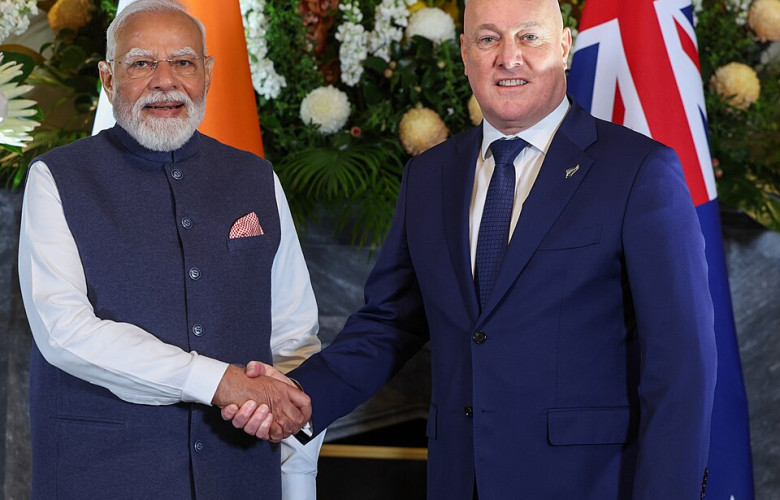
During the two-day visit, Modi and New Zealand Prime Minister Christopher Luxon upgraded their countries’ ties to a full Strategic Partnership, backed by a four-year "Roadmap to 2030" spanning defence, trade, maritime security, agriculture, tourism, sports, culture and science. The visit builds on the India–New Zealand Free Trade Agreement (FTA), signed on April 27, 2026, and confirms that a relationship long below its potential has entered a new phase.
India's importance to New Zealand's long-term strategy
As of December 2025, India ranked as New Zealand's 11th-largest export destination for goods and services combined, accounting for about 1.8% of total exports. Two-way trade between the countries reached NZ$3.95 billion (roughly $2.4 billion) in the year ending December 2025. New Zealand exported NZ$2.03 billion ($1.2 billion) worth of goods and services to India in that period, making India its 21st-largest market for goods and fifth-largest for services.
These figures understate India's importance to New Zealand's long-term strategy. India is among the fastest-growing major economies and is projected to become the world's third-largest economy by 2030, with GDP estimated at around $7 trillion (NZ$12 trillion). Its middle class is expected to exceed 700 million people, creating one of the largest consumer markets on Earth.
During the Auckland visit, Modi and Luxon set a formal target: New Zealand and India will aim to double bilateral trade to NZ$7 billion (about $4.2 billion) by 2030.
What the FTA delivers
Under the FTA, New Zealand grants immediate duty-free access to all Indian exports. India, in turn, will eliminate or reduce tariffs on products accounting for about 95% of New Zealand's current exports, while maintaining protection for sensitive sectors such as dairy and selected agricultural products.
Described by India's commerce ministry as a "once-in-a-generation agreement," the FTA was concluded in just nine months after negotiations resumed in March 2025, one of India's fastest-negotiated trade deals. It has not yet entered into force. As of July, legal teams in both countries are completing technical scrutiny of the text while enabling legislation moves through the Indian and New Zealand parliaments. New Zealand's opposition Labour Party has pledged bipartisan support to speed up ratification. Both governments aim to bring the agreement into operation before the end of 2026.
From trade deal to strategic partnership
Modi's visit produced 18 outcomes, including ten agreements and memorandums of understanding, that go well beyond trade. The centre piece, the Roadmap to 2030, sets a four-year framework for cooperation across defence, trade, maritime security, tourism, agriculture, sports, scientific research, people-to-people exchanges and multilateral engagement.
Defence and maritime security dominated the agenda. India and New Zealand concluded a Mutual Logistics Support Arrangement enabling the Indian Navy and the New Zealand Defence Force to access each other's facilities for refuelling, replenishment and maintenance during deployments. The two countries also signed a Memorandum of Arrangement on Maritime Cooperation to strengthen dialogue, operational coordination and information-sharing across the Indo-Pacific. They agreed to establish a Maritime Security Dialogue, and New Zealand will lead the maritime-security pillar of India's Indo-Pacific Oceans Initiative, focusing on illegal, unreported and unregulated fishing. A new Joint Working Group on Counter-Terrorism will deepen intelligence-sharing and coordination.
Māori interests written into the agreement
As with every New Zealand free trade agreement concluded since 2001, the FTA carries a Treaty of Waitangi clause, safeguarding New Zealand's ability to adopt policy measures it considers necessary to honour its obligations to Māori. The FTA also includes a dedicated Cultural, Trade, Traditional Knowledge and Economic Cooperation Chapter covering traditional knowledge, traditional medicines and rongoā Māori, the traditional healing practices of the Māori people, a notable step for a trade agreement of this kind.
The deal brings concrete economic gains for Māori enterprises. Mānuka honey, a product of deep cultural and commercial significance to Māori, will see a 75% reduction in India's current 66% tariff over five years, making New Zealand the first country to secure preferential honey access under any Indian free trade agreement. Additional tariff cuts in forestry and sheep meat, sectors with strong Māori representation, will further strengthen Māori exporters' position in the Indian market.
Indian diaspora in New Zealand
New Zealand’s National Interest Analysis stressed that “the absence of a Free Trade Agreement with India has been a significant gap in New Zealand’s network of FTAs” particularly given the “geopolitical significance of India,” and the fact that the Indian diaspora in New Zealand is about 300,000 strong, making up around six percent of the population.
As Prime Minister Christopher Luxon noted, “New Zealand’s vibrant Indian diaspora is central to the strong relationship between our two countries.” India’s Prime Minister Narendra Modi has also described the diaspora as a “living bridge” between New Zealand and India. These statements highlight the importance of people-to-people connections in deepening political and economic bilateral partnership.
Why The FTA matters
The recent conclusion of the FTA has importance beyond trade. The upgrade to a Strategic Partnership situates the relationship within a broader contest for influence in the Indo-Pacific. Both countries support a peaceful, stable and prosperous Indo-Pacific region. As trade-dependent nations reliant on secure maritime routes, they share an interest in a rules-based regional order.
For New Zealand, deeper ties with India support an effort to diversify trade links beyond its traditional dependence on China. India is unlikely to displace China as New Zealand's largest trading partner soon, but it offers one of the more significant long-term growth opportunities, given India's younger population against China's aging one. For India, the partnership adds another link in its expanding Indo-Pacific engagement.
Both governments have laid out an initial rollout plan: complete FTA ratification this year, convene the first Maritime Security Dialogue later in 2026, and begin joint agricultural technical work in early 2027 on food safety, cold-chain technology, sustainable dairy production and horticulture.
Modi's visit, the first by an Indian prime minister in four decades, suggests India now regards New Zealand as a partner of real economic and political value, and gives the relationship a firmer foundation to build on.
Image - Prime Minister's Office (GODL-India), GODL-India <https://data.gov.in/sites/default/files/Gazette_Notification_OGDL.pdf>, via Wikimedia Commons

Membership
NZIIA membership is open to anyone interested in understanding the importance of global affairs to the political and economic well-being of New Zealand.