Mecca Agreement: the new Saudi Arabia, Pakistan & Türkiye defence pact that could shake up the Middle East
Dr Geoffrey Miller, Geopolitical and strategic analyst
2026-08-12
MIDDLE EAST
DEFENCE AND SECURITY
This article was first published in Gulf States Insights on 9 August 2026.
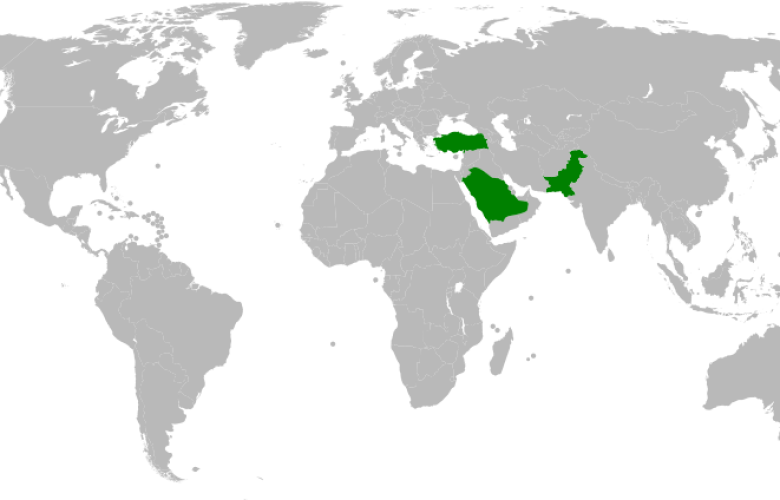
The new ‘Mecca Joint Defence Agreement’ was signed in Islam’s holiest city on Friday by Saudi Crown Prince Mohammed bin Salman, Turkish President Recep Tayyip Erdoğan and Pakistani Prime Minister Shehbaz Sharif.
But despite the powerful symbolism, analysts are divided as to how meaningful the new Mecca Agreement will be.
What the agreement is all about
It’s being sold as a mutual defence agreement, akin to NATO. Here’s the crucial element from a joint statement issued by Saudi Arabia, Pakistan and Türkiye on Friday 7 August 2026:
"The agreement is intended to strengthen collective deterrence against any act of aggression, and stipulates that any armed attack against any one of the three states shall be regarded as an attack against them all. It further provides for the enhancement of all aspects of defense cooperation among the three states."
It’s worth reading the full joint statement - which is not particularly long or complicated - to see this section in context.
Why the devil is in the detail
On the face of it, the phrasing on an attack on any one of the three countries being viewed as ‘an attack against them all’ seems categorical - and it is. But unlike NATO, there is no detail - at least not yet - on the extent of any collective response that can be expected. Will there be an obligation to respond - and if so, how?
Similar language to the Mecca Agreement announcement was used by Saudi Arabia and Pakistan in an announcement of an earlier mutual defence pact in September 2025, which forms the basis of the expanded agreement with Türkiye.
But despite extensive attacks on Saudi Arabia this year by both Iran and the Houthis, Pakistan’s direct military support for Saudi Arabia has been limited, at least publicly.
Still, the new pact could easily be more powerful - and its symbolic force is also highly significant.
What commentators are saying
Analysts from the Gulf and beyond are grappling with what the new agreement means - and just how significant it might be.
In a thread on X, prominent British scholar H.A. Hellyer called the deal ‘potentially one of the most consequential strategic developments in MENA [Middle East and North Africa] in years. An attempt at regional order-building - and preventing two counter orders (Iranian/Israeli) solidifying’.
He added ‘Riyadh increasingly sees regional stability requiring a balance of power—not domination by Tehran, but equally not a regional hierarchy centred on Israeli paramountcy. The pact institutionalises that logic.’
Like other analysts, Hellyer also noted the complementarity of the three partners, with Saudi money, Turkish military technology and Pakistani’s military firepower and nuclear weaponry.
Meanwhile, Dania Thafer, director of the Gulf International Forum thinktank, said the new pact was an ‘an elastic defense agreement—designed to flex across multiple fronts beyond just Iran and Israel—building a layered deterrent that taps Turkish drones and Pakistan’s nuclear shadow. Also, it hedges against what many in the Gulf see as an increasingly unreliable U.S. security umbrella without rupturing ties to Washington’.
And Turkish-British analyst Ziya Meral urged for the deal to be judged on its own merits: ‘Reading it merely through Sunni-Shiite or ‘Muslim NATO’ ‘Sunni alliance’ framing would be misleading.. Similarly, reading all of this through ‘Israel vs rest’ framing and lens as I see in some DC based takes is far from healthy’.
The Saudi perspective
A common theme of Saudi views is that the deal’s very symbolism carries significant weight - projecting deterrence (especially towards Iran) and diversification of relationships at the same time.
For example, retired Brigadier General Faisal Hamad told Saudi news channel Al Arabiya: ‘This agreement is a sovereign right of any state, and this is a very important message that the world must understand. Any state has the sovereign right to form alliances that it deems to serve its interests and common interests. However, when we talk about any attack on one state being an attack on the others, this is a message of deterrence’.
Meanwhile, influential Saudi analyst Abdulaziz Sager told Reuters: ‘Three of the Muslim world's most influential states are convening at a moment of heightened uncertainty, demonstrating a growing willingness among regional and middle powers to coordinate more closely on security matters’.
And Hesham Alghannam, a Saudi scholar at the Malcolm H. Kerr Carnegie Middle East Center, suggested in an Arabic post on X that the new alliance aims to build an Arab and Muslim alliance against Iran:
'As for its goals, they are clearer in the aspect of what it seeks to prevent rather than what it seeks to build. In other words, it aims to contain Iran's maritime influence and its network of proxies, prevent the formulation of any post-war regional system with Israel at its center, and entrench the principle that #regional security is primarily an Arab and Islamic responsibility, rather than a project relying solely on the #Western umbrella.'
Gulf viewpoints
It’s also interesting to look at the reaction from elsewhere in the Gulf. Several Qatari analysts showed openness to the agreement - perhaps because Qatar has a good defence relationship of its own with Türkiye.
Abdulla Banndar Al-Etaibi, an assistant professor at Qatar University, wrote this before the deal was officially announced:
'If confirmed the Mecca Agreement would be more than a defense pact, it would signal a shift toward a more regionally driven security order. The name itself also carries strong symbolic weight, emphasizing unity and shared strategic purpose.'
UAE reaction was more circumspect, reflecting quite a different strategy from Abu Dhabi - the UAE has been emphasising cooperation with the United States and Israel, along with quiet diplomacy with Iran.
Emirati analyst Abdulkhaleq Abdulla wrote in Arabic on X.
'Congratulations on the establishment of this alliance, but strengthening Gulf military and political cooperation and unifying the Gulf house is far more important than investing in regional military and political cooperation that includes countries whose credibility and ability to confront the Iranian-Israeli threat are not taken seriously. One of the conditions for the success of any alliance is identifying the common enemy. So who is the enemy for the countries of this alliance?'
Ultimately, the exact significance of the new Mecca Agreement mutual defence pact between Saudi Arabia, Türkiye & Pakistan remains to be seen.
Will it be symbolic or substantive? And will it expand to include other members - such as Egypt?
Over time, there will be some answers - but for now, the debate continues.
Subscribe to Gulf States Insights on Substack here.
Image ARABCREATOR7, CC0, via Wikimedia Commons

Membership
NZIIA membership is open to anyone interested in understanding the importance of global affairs to the political and economic well-being of New Zealand.