The Indo-Pacific’s defining dilemma for democracies
Roberto Rabel, Victoria University of Wellington
2026-02-26
ASIA
GEOPOLITICS
This article first appeared on the East Asia Forum
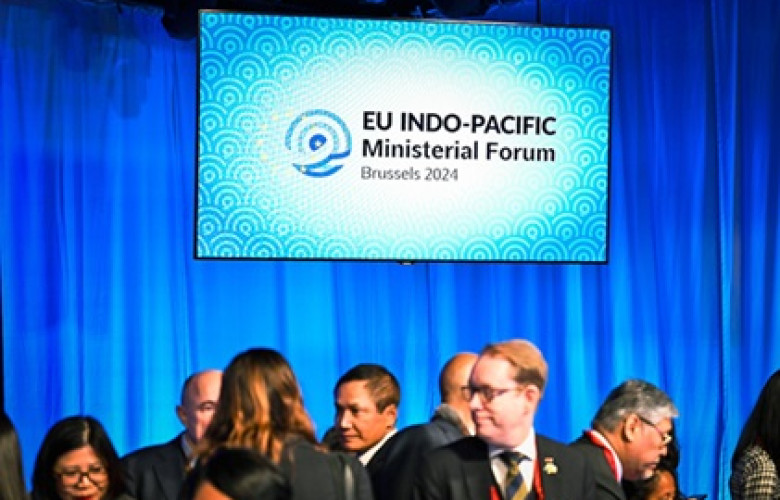
Primarily geostrategic in impetus, this effort has been driven by major democracies — especially the United States, India, Japan and Australia. Given that it is singularly their initiative, democracies need to be clear about what exactly they are promoting.
But the Indo-Pacific idea remains hobbled by a dilemma regarding its geographical scope. Academics tend to fudge this issue, while policymakers are less coy, spelling out publicly what their Indo-Pacific strategies encompass in geographic scale. The result has been a set of definitions of the region that differ substantially.
This defining dilemma raises at least two important issues — namely, the implications of discrepant geographic understandings of the Indo-Pacific for like-minded countries promoting a ‘free, open and inclusive’ region, and the prospects for resolving the dilemma.
Definitions of the region in official strategies differ confusingly. The 2022 Indo-Pacific Strategy of the United States describes a region ‘stretching from our Pacific coastline to the Indian Ocean’. In contrast, the European Union’s 2021 Strategy for Cooperation in the Indo-Pacific depicts a region ‘spanning from the east coast of Africa to the Pacific Island States’, which excludes the United States and other Pacific-facing states from the Americas, as well as Russia. Australia, India, Japan and New Zealand similarly reference differing variants of how they understand the region. In response, China, arguably the most important power in the Indo-Pacific, has dismissed the concept as ‘foam on the ocean’.
Ignoring these discrepancies constrains the ability of democracies promoting the concept to realise their regional visions. As well as engendering confusion, it makes it difficult to nurture social license for reconceptualising the Asia Pacific as the Indo-Pacific. The lack of institutions styled as Indo-Pacific compounds this problem, as does the continued prevalence of Asia Pacific bodies such as Asia-Pacific Economic Cooperation and ASEAN-centred regional forums. This allows China to buttress its claim that the Indo-Pacific formulation is a plot to contain its legitimate rise in response to receding Western influence in the Asia Pacific region.
Addressing the challenges raised by these discrepant definitions firstly requires a reflection on the tendency to conflate geostrategic objectives with a regional reframing, which necessitates defining this ‘new’ region in contradistinction to the Asia Pacific. If one factor behind the term Indo-Pacific is to acknowledge India’s rising importance, facilitating its entry into more Asia Pacific-styled institutions would achieve the same end. More generally, democracies could simply acknowledge that their primary aim is to advance ‘free, open and inclusive’ attributes that would benefit all regional players, rather than rationalising their strategies in the context of a refashioned region.
There is a strong case for democracies to rethink the relative costs and benefits of a concept claiming to define a region whose proponents cannot even agree about its geographical limits. While the Asia Pacific also has somewhat imprecise boundaries, it has enjoyed widespread acceptance for decades and, in practice, is more inclusive than the Indo-Pacific as currently conceived. Moving away from the Indo-Pacific terminology would help restore that previous sense of inclusiveness, associated with Asia-Pacific nomenclature and institutions. It would thereby send a powerful signal to China, ASEAN states and others that major democratic powers are genuinely committed to an inclusive region in which both like-minded and unlike-minded states can coexist peacefully and thrive economically.
Democracies’ choice to continue with the more questionably defined and competing Indo-Pacific framework as opposed to a ‘free, open and inclusive’ Asia Pacific may reflect concerns over sunk reputational costs. Still, such a shift is not impossible and would highlight the self-corrective advantages of democracies.
A lack of clarity about definitions signals confusion about strategic intentions. For instance, there is a glaring lack of self-awareness in claiming ‘inclusiveness’ when perceived unlike-minded states, such as China and Russia, were not consulted in the region’s reconceptualisation. It is notable that democracies long accepted the Asia Pacific designation for the region. As recently as the former Obama administration’s so-called ‘pivot’ or ‘rebalance’ to Asia, official US documents referenced ‘Asia and the Pacific’, with no mention of the so-called Indo-Pacific.
In practice, Asia Pacific multilateral institutions have been guided more by function than geopolitics. Distinct geographical definitions mattered little to delimit a region which evolved in response to mutually beneficial linkages, with politics and economics developing in tandem.
Despite the challenges confronting the organic Asia Pacific model amid growing great-power competition, it may still offer a more viable path for regional stability and prosperity. Its adaptation is possible, especially if the values encapsulated in the ‘free, open and inclusive’ rubric are incorporated in ways that China and other unlike-minded states cannot reject outright.
Only minor adjustments of the Asia Pacific conceptualisation would be needed to include India, such as allowing its membership in APEC. Nor does an Asia-Pacific framing preclude acknowledging the connectedness of the Indian and Pacific Oceans — as envisaged in the Obama administration’s ‘rebalance’ policy and in ways that unlike-minded states can accept. Such an approach would retain the Asia Pacific’s strength as a platform for dialogue, rather than proselytising about a new region lacking clear geographical limits.
Definitions matter when it comes to regions. When definitions clash with regional realities, they highlight the need to reconsider what lies behind them. Democracies should consider why the challenge of delimiting the Indo-Pacific highlights a dilemma of their own making — one that they should resolve if their objectives are to be realised substantively.
Photo: This file is licensed under the Creative Commons Attribution 2.0 Generic license.

Membership
NZIIA membership is open to anyone interested in understanding the importance of global affairs to the political and economic well-being of New Zealand.